Showing posts with label Flipped Classroom. Show all posts

Assess like a parent, not a teacher.


For those of you that are parents, have you ever given your child a multiple choice test over life lessons?  Have you ever given them a true/false quiz on how to treat other people?   Ever give them a constructed response question on how to do the laundry?  Of course not, but how could you possibly know if they are learning without a stream of data to analyze.

You talk to them.

Remember the movie Dr. Doolittle, yeah the original from 1967.  He is so excited when he realizes he can talk to the animals.  He can't wait for all the conversations and things he can learn from them and about them.  Why don't we do this more in our classes?  Have the kids explain everything.  They can present to the class or present to each other.  Have them present to you through a conversation one-on-one.  When you walk away from a student you should know exactly where they stand.  Not to mention all these conversations are building a better relationship with each kid.  This will immediately strengthen your class.

The first thing you have to do is flip the teacher, not flip your class.  As teachers, it was common to take home papers and grade them, doing the assessment outside of class.  That has to be flipped.   Justin and I do the majority of our assessing in class.  And outside of class, we are searching for new project ideas and setups for future activities.  Almost every assessment we do has a conversation piece where we talk back and forth with the student about what they learned and the outcomes of the project.

I was working in the garden with my 6 year old, Sydney, and she popped open a pea and started eating the peas out of the pod.  I asked her what she was doing and she said the dark green peas need to be popped out and the lighter ones are better left in the pod.  I asked her how she figured this out and she said the dark peas weren't sweet enough and she wondered why.  I learned more from her and about her knowledge of peas in that two minute conversation than I ever could have from the way we currently assess our students in school.

In our fast changing classrooms where there are huge pushes for 1:1 with technology, project based learning, web tools, 21st century skills, and all of the other new ideas- the one that will make the biggest change in your classroom culture and your kids is to assess through conversations.  Flip the teacher and assess your students the way parents raise their kids and take Dr. Doolittle's advice and "talk to the animals."


Why Chrome is the Most Amazing Browser

People don't like to talk about religion and politics because people are generally set in their ways and emotions gets high.  This is how I feel towards web browsers (nerd alert), and like any religious zealot, I am completely convinced I am right!  However, this is no leap of faith.  Google Chrome is, by any measure, the best web browser available and anyone who doesn't agree simply doesn't know what Chrome can do. This is especially true for educators and students.

Speed is thought to be a major issue with web browsers, and you can find speed tests that favor just about any browser, except maybe Internet Explorer.  I personally think Chrome is faster after using IE, Firefox, and Safari on a fairly regular basis, however, Internet speed is more linked to your Internet connection and computer processor than it is to your browser.

The real beauty of Google Chrome is the apps and extensions.  For those who don't know, web extensions (also called add-on too) are essentially mini-programs that work within your web browser.  Some of my favorites are Evernote Web clipper, Diigo Highlight/bookmarking tool, Explain and Send (screenshots), Black Menu (for easy access to all your Google Apps), and Aviary image editor for Google Drive--this is important when working in Google Presentation to edit and crop images.  The Google Chrome Store is full of thousands of other extensions and apps such as Ancient History Encyclopedia--and they are almost all FREE.

There are many other benefits too.  Google Chrome automatically updates, so there is no need to ever update the software.  Do you ever leave your browser open so you don't lose the tabs you have open?  Chrome allows you to close your browser and continue where you left off.   Possibly the greatest benefit is the fact that it is 100% web-based.  What does that mean?  I can log into Chrome (Google account) on my desktop and have the same apps and extensions I have on my laptop. I can log into my account on my friend's computer, library computer--ANYWHERE and have all the same apps, extensions, web history, bookmarks, etc. as I do on my personal laptop.  Not to mention the incalculable value of all the other Google Apps, which I've blogged about before here and here.  I don't want to live in digital world without Google.  You won't either when you discover the glory of Google.


The End of Homework

I emancipated my students from the shackles of homework nearly two years ago. I began to realize that the burden of homework fell heavy on students and teachers. I had been reading and listening to abolitionists such as Alfie Kohn, Joe Bower, and Mark Barnes for a few years. I began to realize that students had lives outside of school, they learned outside of school, and homework was alienating them from an education they already saw as obsolete and meaningless.

Homework is not worth it. Its not worth enforcement measures, disciplining noncompliance, increasing hatred of "learning" and school, or the TIME. Students come to school for 8 hours. How can we realistically expect them to do 2-3 hours of homework after 8 hours of school work. Sports? Job? What about family time or hobbies? In our culture? Sure, we can fight it, but where does it get us? 

 On the other side of the coin, how many students succeed BECAUSE of homework? How many would not learn without homework? It can be argued that repetition assists memorization. While that is sometimes true, I have very little interest in memorization. Besides, this type of learning is temporary.

I haven't regretted my decision for one second. Students do my work in class. If they waste their class time, they may have to make it up at home. My students are learning at least as much, probably more, as they ever have. I don't believe that assigning students additional work away from the person that can facilitate the learning behind that work is a good way to increase learning. Thanks to Joe Bower, I have a great new saying, "homework should be inspired, not assigned". Many of my students now voluntarily work on their projects at home. Others look up related information and we discuss it in class.

Flipped Class: A Second Look

Last year I did a Flipped Class experiment.  The Flipped Class model seems to penetrate every corner of my PLN (professional learning network).  I had to have a taste of the model that I was admittedly skeptical of.  The main question I tried to answer was, "Would students actually do their homework if it was engaging instructional material rather than practice work?".  The clear answer was no.  Using anonymous surveys to encourage honesty, I never had more than 70% of students who had watched the instructional video before coming to class.  Some commenters on my blog suggested activities (worksheets/quizzes) in tandem with the videos, which I saw as traditional homework and an eventual enforcement issue.

Ok, full disclosure--I was very skeptical of this model to begin with because I have completely divorced my class from traditional homework.  My homework now follows one simple rule, inspired by a quote from Joe Bower: "homework should be inspired, not assigned".  Eight hours at school is enough, homework has little to no effect on comprehension, and it's not worth the enforcement and grade damage that often follows.  I want my class to be so engaging that kids want to go home and learn more or work on their project because they are invested in it--not because I make them.

Photo--http://www.republican-eagle.com/ 
However, I continue to read about the Flipped Class, and I have a new perspective.  I still won't use this model in my class, but now I understand the draw.  The popularity/effectiveness is less about the instructional homework as it is about the change in classroom dynamic.  As a class moves from a traditional model to Flipped, the teacher spends class time working one-on-one with students as they work through class activities.  The teacher tutors and formatively assesses all at the same time.  Teachers become more of a facilitator than the sage on the stage.

I think this one-on-one environment is the major draw for the Flipped Class and its the primary reason for any success it enjoys.  This is how my class works too, but without the homework instruction.  I mainly use the project-based model or a simpler version I call PBL-Light.  I remain very skeptical of any homework, especially instruction without facilitation.  In my opinion, the Flipped Class model could work if you ignited a fire of interest before class ended and provided an engaging video for students to find out more at home if they are so inclined.  All that being said, to each their own--we all need to find the method, combination, or mutation of methods that works with our own philosophy and personality.  I just had this epiphany about the real power behind the Flipped Class and thought it was worth a second mention.

Flipping the Teacher

As educators slowly transition into a more progressive form of pedagogy and assessment our role changes  in many ways.  We become less of an instructor and more of a guide.  We become less a "teacher", and more of a student. The dynamic of how we work is also changing.  In a conversation with my consigliere, Joey Till, he pointed out exactly what we are doing--we are flipping the teacher.

In the 20th Century it was very typical for teachers to put together their lessons while they were in school--preparing materials, making copies, etc.  Of course, teachers worked at home too---usually grading papers of some kind.  What we are doing now flips our work dynamic.  I sit on my wonderfully comfortable couch and put my lessons together.  On nice days, I like to sit outside and smell the flowers and listen to the birds while I think of interesting projects and ways to breath some life into my otherwise boring content standards.

While I'm in school I spend a great deal of time "grading".  Of course, I don't mean I grading papers.  I sit down with groups or individuals and use conversations as formative assessment.  When its time to decide on a grade, we have another conversation.  I ask content questions.  We look at the requirements, I tell them my formative observations, and they decide an appropriate grade, which is almost always right where I think they should be.  Another way I am increasingly "grading" in school is using student presentations.  I blogged about the instructional value of student presentations, but obviously this is also a good time for assessment.

Some of the teachers I have worked with express concern about the additional planning time that  project-based curriculum may require.  Some of the worry could be relieved if they learn that "grading" doesn't mean sifting through stacks of papers at home every night. 

Content Delivery is Not Learning

I saw a tweet this week from Katrina Stevens that was sort of a 'ah ha' moment for me.  Now that I have had time reflect, I can't believe I never reached the same conclusion.  Many people assume content delivery equals learning.  We make this assumption about learning when we assign 2 chapters of reading for homework, but we think its different when we turn the reading into a video.

The recent influx of technology has spurred a whirlwind of content delivery ideas and teaching methods.  Prezi, the Khan Academy and the Flipped Class are a few popular examples.  The 1:1 movement has movivated teachers and adminstrators to make assumptions about learning:
'If our worksheets are on the computer, kids will like them and learn more'.
'If my lecture is recorded on video students can re-watch it and they will learn more.'
'Delivering content with technology makes students learn more.'
'If students watch a snappy video they will learn the content.' 

Some of these imaginary quotes are obviously hyperbole, but I've said or assumed maybe a few of those.  Have you at one time?  Obviously content needs to reach students in some fashion, but I think that is the pedagogical problem many teachers are facing.  They are trying to reach the kids with content.  What we need to do is motivate our kids to want to reach for the content themselves.  Learning is authentic, its chaotic, and it happens to each student in a unique way.

Some people defend content delivery by saying they have done this for years and it works--they have the test scores to prove it.  I think they may have found a clever way to encourage or enforce memorization, but I don't equate that to real learning.  I think it would do more for our culture and community to have a room full of curious kids who have more questions than answers.

Intrigue

Students must be intrigued and inspired to learn.  All of us do.  As adults, why would we learn about something if we are not interested.  Would you pick up a book about a topic you don't like?   Back when public education started it was easier to gain the interest of our students.  Schools were the only place where people could be intrigued about anything beyond their daily grind.  The public library began a shift away from schools.  Radio and printed material for all ages (comic books) intrigued the youth.  I think school began its movement toward obsolescence when the television became a popular home item.  Cable made it worse.  Home gaming systems and the Internet were the final nail in our coffin of boring obsolescence.  This is how many kids see traditional schooling. Can you blame them?


I had this thought as I was making my last 2 videos for my Flipped experiment.  I used ahead.com to create a presentation.  From what I have heard, it is similar to Prezi.  The kids were SO into it.  They were clicking through, reading slides, zooming around; they loved it.  They were intrigued.  I think this is the value of using presentation tools beyond PowerPoint.  We become a one-trick pony.  The show gets boring and we lose our kids.  Granted this type of intrigue is short-lived.  Its a new toy on Christmas that gets forgotten by New Years.  Even though the intrigue is temporary it increases your skills and deepens your repertoire.  On a separate note, the web-based tools I have been exploring lately are really impressive.  I have always believed Apple had the edge on the creative market when it comes to software, but the web-based tools are giving Apple a run for their money.  If this trend continues, I might actually be convinced that Chromebooks are a better device than a Macbook for schools.  Sorry Apple.

Flipped Classroom Report 2 and Homework

I really regret this experiment.  I was ready to trash this idea on Tuesday.  I can already see the problems with a Flipped Classroom, but in the name of science I want to give it a fair shake.  Our school is 1:1 with Macbooks in grades 6-8, but next year grades 4-12 will all have their own Mac.  Teachers will be thrust into the wide-open space of a Digital Classroom.  The popular buzz of the Flipped Classroom will tempt our teachers, so I want to gain some solid experience, so I can offer better advice to anyone who wants it.  Obviously this is not a conclusive study.  Other teachers may have more success depending on the students, subject, and organization of their Flipped Class.

On Wednesday, I conducted my second student survey.  The results were very similar to the first survey (click here to see the full data summary).  Most of the kids didn't watch the video on Islamic Architecture, despite my encouragement and reminders of how important it was to the next day's project.  Again, the students that didn't watch the video said they "just forgot".  The only real change was in the increase in the number of students who said they learn "worse" in a Flipped Classroom.
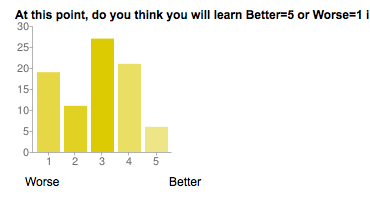
Survey One (1-5 range)
The only difference between the two questions is that Survey One was a range of 1-5, Survey Two was a range of 1-4.  The reason for this change is too many people pick the middle option with an odd number of choices.  An even number (4) forces them to make a clearer choice--research 101.  Most of those that chose the middle option trended toward "worse".

In Survey Two, I added a few new questions.  In one question a majority of students admitted to being distracted when they watched the video.  I feel many more were likely distracted, but they
Survey Two (1-4 range)
might not understand how distracted they actually were.

As I have said before, data doesn't tell the true story.  Even students who told me they watched the video couldn't name basic types of Islamic architecture.

This experiment has taught me one major lesson. Homework is not worth it.  Its not worth risking instruction, enforcement measures, disciplining noncompliance, increasing hatred of "learning" and school, or the TIME.   Students come to school for 8 hours.  How can we realistically expect them to do 2-3 hours of homework after 8 hours of school work.  Sports?  Job?  What about family time or hobbies?  In our culture?  Sure, we can fight it, but where does it get us?  On the other side of the coin, how many students succeed BECAUSE of homework?  How many would not learn without homework?  A Flipped video is just a different version of homework.  We might think, "all you have to do is watch a video".  Homework is homework to most kids.  Thanks to Joe Bower, I have a great new saying, "homework should be inspired, not assigned".   This is my new mission.

Flipped Classroom Report 1

Today was the first day of Flipping my class.  I think my method differs from the traditional model as I don't use quizzes to enforce the instructional videos.   My instructional videos are meant to provide a conceptual framework for the activities in class.  After watching my video today during my prep I realized its a bit dry--I need my goofy nature to shine through in my recorded instruction.  I gave a short anonymous survey today to all my students.  I wanted to see how many students watch the video before class--most of them did NOT watch the video.  It was, however, the first day of our Flipped class and a Monday.  

 For students who answered "No", I asked them why they didn't watch the video.  About 72% said they just forgot.  Only about 8 students out of 84 gave negative reasons for not watching the video. 

Of the students who watched the video, only 3 said they didn't understand the video.  The rest of them said they understood at least some of the video.
I hope this is some indication about the effectiveness of the video.  My next survey will ask about how effective the video was.  I also want to ask the kids for suggestions.  I have read about some people who say you should always include the teacher in the video rather than just a voice.   Despite all of the incredible presentation option, I thought I might go old-school and get out my video camera.  I have a huge projection screen--I can focus the camera on the screen and include myself in the video walking back and forth and pointing things out.  This is closer to the way I teach, so I think it will work better. 

The final question was answered on a scale.  I asked the students--"At this point do you think you will learn better or worse in a Flipped classroom".  This is a question I plan on asking throughout the experiment.

Flipped Classroom?

Overall, I feel pretty good about my 1:1 class.  However, in the tradition of this blog, I'm always looking for new ways to improve.  We have all heard of the "flipped classroom".  This idea has been increasingly popular in education in the past few years.  When I first heard about flipping the classroom I thought it sounded interesting, but I was skeptical.  Part of the concept makes sense--students should be doing the "work" in class with the teacher, not at home without the support they need.  However, doesn't the same logic apply to instruction at home?  How can we expect students to learn without asking questions in the heat of learning?  Homework completion is a problem in school.  The learning in a flipped classroom relies on homework.  This seems like a gamble.

http://edudemic.com/2011/12/15-flipped-classrooms/
In addition, my philosophy about homework has changed over the last few years.  I really don't feel homework has great value, in fact there is a fair amount of research against homework.  Besides, we ask the kids to be at school for 8 hours, now we ask them to do more work at home? 

Despite my misgivings, I have been flirting with this concept for a while, and after a recent conversation with my superintendent, I decided to give the flipped classroom a chance.  Our Macbooks offer us a unique opportunity to create very personalized videos and other presentations in a number of formats.  Besides, I do love a good experiment!  As a man of science, how can I dismiss a theory without testing it?  After ISTEP (Indiana's standardized test), I will start a 2-3 week period of flipping my class.  I plan to use some students surveys and keep careful records of student learning.  I will report my finding and information on this blog.  I will create several videos as the learning materials students will watch at home or on their own time and class time will be used for learning activities and/or one-on-one remediation.  Here is a sample of a a video podcast about the Spread of Islam I made in Keynote and edited in iMovie.  Student will watch this and post a question or comment on my Edmodo page.