Showing posts with label Homework. Show all posts

How to Make the Perfect [Assessment] Cocktail

Assessment can be a sticky issue.  We know best practice is not a multiple choice test, yet that is the preferred method state standardized tests use--due simply to the ease of grading, way to lead by example ;)  So, do we use best practices or inferior methods that prepare students for a bogus test designed primarily for PR and political fodder?  Tough choice right? While it may be an easy philosophical decision.  The pressure from administration can often complicate things.  My general belief is that if a student can pass my assessment, they will do fine in a multiple guess test.


We often sit around and talk about assessment, specifically 'what is the best way to know what students know'.   I think we've concluded that it depends on the situation.  What is best in a science lab is not what is best in twelfth grade AP English.  While the specific assessment models don't always hold true across all the disciplines and developmental levels, the concept usually do.  Such as the concept of self-assessment.  I think this is a powerful assessment concept that should be worked into nearly every activity you wish to use as an a recorded assessment (grade).  However, it isn't always the most reliable option.  Self-assessment is best when balanced by a teacher assessment.  Obviously the teacher provides a needed perspective in the overall assessment of a given activity, and probably should be given the highest weight.  That being said, another valuable perspective are the students' peers.  If the student presents their work to the class, the class should have a say in the assessment.  The same is true of working in groups or presenting to an authentic audience.  A group assessment is a great ingredient to authentic assessment.

If you are truly interested in really learning what your students know its good to account for multiple perspectives.  If you are looking for a fast way to grade... well... find another profession because you're making all the rest of us look bad.  And while we're on the subject its OK not to grade everything you do in your class.  I once met a teacher who took 55 grades in a 9 week period---thats 1.2 grades per day!  To sum up, assessment is best thought of like a cocktail.  One part self assessment, one part group assessment, and one part teacher assessment... and, it should always be used responsibly.

Building Better Homework

Homework is one of the pillars of traditional education.  It's a nearly universal concept in K-12.  However, stress fractures have started to form recently due to the tide of support for homework reform voiced by students, parents, and education reformers.  I've never felt good about the concept of homework, especially as a student who worked and played sports through most of high school.  Now as the parent of a 1st grader who regularly gets math and reading homework I can see how much "extra practice" cuts into the valuable daylight hours kids have after they get home from school.   I've written before about my abolitionist spirt in regard to homework.  I feel home practice can have value, but I really think a guiding principle comes from Joe Bower, "homework should be inspired, not assigned".

Recently one of my colleagues, Amy Degitz, at Wabash Middle School came up with an ingenious idea for homework.  She was studying Ancient Rome and designed a project-based learning lesson where students were required to build a model of something from Ancient Rome, but they had to build it at home.  Their homework assignment was to build.  They had to apply what they were learning in school to a home build project that most of them were very exciting to do (see trebuchet on the right).  I plan on having Amy write a guest blog to give more details, but Amy had another stroke of brilliance.  She made all the students write a proposal for their build and sign a contract that their parents had to sign, agreeing to the final product, work time, and due date for their project.  Students made everything from an aqueduct to Roman armor.

Everyone was on the same page with the project due to the contract.  The students were excited and motivated and they REALLY knew their stuff!  Talk about a win-win.  I was lucky enough to be a judge and grill several of the kids with questions.  I was shocked at how much they knew about their particular build topic and its connection to Rome.  Like any good teacher, I stole this idea immediately.  In fact, I called an audible right in the middle of my current world religions project and inserted a home build component with a contract for students and parents.  They were very excited!  We started three days ago and I've already received about a dozen emails over the weekend about advice on their projects.  Students will have about 2 weeks to finish their home build and I will make this a regular part of my class.  To me, this is what homework should be--not worksheets or other mindless memorization exercises.  Homework should be an engaging, authentic, creative application of what students are learning in school.  A home build is a great concept to build better homework.


Computer Club

The summer before my school went 1 to 1, we tried to prepare for any foreseeable problems our students, parents, or teachers might encounter.  One issue was Internet access. There are many in our community who suffer from unemployment or underemployment and roughly 70% of our students receive free or reduced lunch.  What are students supposed to do if they have homework and they need the Internet to complete their work?  While they likely have local hotspots, friends, or relatives who have Internet, as a school we can't ask them to "just figure it out" without a reasonable option.  My experience has been that students are efficient excuse machines, and if given any legitimacy, they, and their parents, will overrun you.

Thus, the creation of Computer Club.  Computer club is an after school, supervised place for students to  work on homework or just hangout and use the school's Internet access.  This is also a place to get help with computers.  Teachers often send student to me in Computer Club to learn how to use iMovie, iPhoto, or some web tool.  Teachers themselves regularly drop in to get tech advice or troubleshoot a problem.

To be fair, lots of kids come to Computer Club to play non-educational games like Minecraft, and hang out with their friends. However, one could argue this is a great alternative to having them walking around town getting into trouble or returning to an empty house because their parents are at work.  Last week I sat up and surveyed the kids in Computer Club.  There were several athletes using it as a pre-practice study hall, there were 2 kids discussing their new blog and how to promote it, our APAX News Team was planning their next broadcast, about 12 hardcore Minecraft builders hunched over their computer, and another 6 or 7 kids floating from group to group socializing and casually working on homework.  It was exciting to see kids engaged in what they were doing and having fun in school.  Computer Club has been an integral part of our 1:1 plan, it has also become a time for clubs to assemble like APAX News Team and the new upstart SWAT Team (Students Working to Assist Technology).  Great things are happening in little Wabash, Indiana, and like our announcements regularly say, "its a great day to be an Apache".

K-12 Alignment

Districts have made attempts to align their curriculum from kindergarten to grade 12 for years.  Common Core standards and state content standards before them furthered this idea.  I reflected on this idea recently with a colleague and we had an epiphany. It shouldn't be K-12 alignment, it should be H-12 alignment.  The "H" stands for home.  The inclusion of parents has been the missing link in curricular alignment.  It has been pointed out recently by a great video produced by NBC that students who come to school behind their classmates fall further behind every year especially during the summer.  Why have we never seriously addressed this?

There are no easy solutions, but schools must make a revolutionary effort to bring parents into the schools, not just in elementary, but through student's senior year.  It seems parent involvement wanes as students work their way through school.  Parent-teacher conferences twice a year is a paltry attempt to involve parents in their student's education.  Parents need to be in the school, have knowledge of and participate in learning activities, and also be held accountable to their student's education.  Teachers are held to the highest order of accountability for a student they have for an hour each day.  Isn't there some kind of incentive we could offer parents?  Clearly the incentive of a better education is not enough.  What about free textbook rental?  What about a tax credit?  If we want to revolutionize American education and compete in a global world, education must begin and be sustained at home.


The End of Homework

I emancipated my students from the shackles of homework nearly two years ago. I began to realize that the burden of homework fell heavy on students and teachers. I had been reading and listening to abolitionists such as Alfie Kohn, Joe Bower, and Mark Barnes for a few years. I began to realize that students had lives outside of school, they learned outside of school, and homework was alienating them from an education they already saw as obsolete and meaningless.

Homework is not worth it. Its not worth enforcement measures, disciplining noncompliance, increasing hatred of "learning" and school, or the TIME. Students come to school for 8 hours. How can we realistically expect them to do 2-3 hours of homework after 8 hours of school work. Sports? Job? What about family time or hobbies? In our culture? Sure, we can fight it, but where does it get us? 

 On the other side of the coin, how many students succeed BECAUSE of homework? How many would not learn without homework? It can be argued that repetition assists memorization. While that is sometimes true, I have very little interest in memorization. Besides, this type of learning is temporary.

I haven't regretted my decision for one second. Students do my work in class. If they waste their class time, they may have to make it up at home. My students are learning at least as much, probably more, as they ever have. I don't believe that assigning students additional work away from the person that can facilitate the learning behind that work is a good way to increase learning. Thanks to Joe Bower, I have a great new saying, "homework should be inspired, not assigned". Many of my students now voluntarily work on their projects at home. Others look up related information and we discuss it in class.

Creative vs. Mechanical Intelligence

Last week my students were learning how to read charts and graphs.  We were identifying the parts of a  graph and learning how to approach complicated charts before we created our own infographics next week.  I prepared a few graphs for the students.  I cropped the title and X and Y axis labels off of one line graph.  I asked the students to suggest what the title SHOULD be based on the available information on the graph.  Obviously, there wasn't a specifically right or wrong answer, and most students chose something related to the key words still on the graph.

To my surprise, there were a few students who struggled with this.  There were several more that left it blank because they couldn't "find" the answer.  One student in particular really blew my mind and opened my eyes to different types of intelligences.  This student was a straight "A" student last year.  The conversation went something like this:
student-"I don't get the question"
me-"Based on what you can see, what SHOULD the title be?"
student-"I don't know because you cut it off"
me-"I know, I want you to use what you do know and create a new title that is appropriate."
student-(frustrated)"How can I get the right title if I can't see it?"
me-"I don't want you to guess the original title, I want you to be creative and write a totally new title that explains what is going on in the graph"
student-(looking away from her computer, sitting in silence, visibly frustrated now)
me-"Don't worry, there are lots of right answers"
student-(no response, bell rings and she leaves)
The next day, I sat down with her to "grade out" as we call it.  She had left the question blank.  I told her that I expect every question to be answered.  I tried to explain that there won't always be a clear answer this year, that she will need to be creative.  She seemed to accept it, but I could tell it bothered her.  This is a fantastic student, clearly very smart, but befuddled when a clear answer is not presented in the text.  I think this situation is a symptom of traditional education.  For too long we have told students there is only 1 answer.  This has created students that are mechanically intelligent, but lack creativity when given more open ended questions.  The world demands creative thinkers, and this student is not being served by an education that tells her there in only 1 answer to every question.

Flipped Class: A Second Look

Last year I did a Flipped Class experiment.  The Flipped Class model seems to penetrate every corner of my PLN (professional learning network).  I had to have a taste of the model that I was admittedly skeptical of.  The main question I tried to answer was, "Would students actually do their homework if it was engaging instructional material rather than practice work?".  The clear answer was no.  Using anonymous surveys to encourage honesty, I never had more than 70% of students who had watched the instructional video before coming to class.  Some commenters on my blog suggested activities (worksheets/quizzes) in tandem with the videos, which I saw as traditional homework and an eventual enforcement issue.

Ok, full disclosure--I was very skeptical of this model to begin with because I have completely divorced my class from traditional homework.  My homework now follows one simple rule, inspired by a quote from Joe Bower: "homework should be inspired, not assigned".  Eight hours at school is enough, homework has little to no effect on comprehension, and it's not worth the enforcement and grade damage that often follows.  I want my class to be so engaging that kids want to go home and learn more or work on their project because they are invested in it--not because I make them.

Photo--http://www.republican-eagle.com/ 
However, I continue to read about the Flipped Class, and I have a new perspective.  I still won't use this model in my class, but now I understand the draw.  The popularity/effectiveness is less about the instructional homework as it is about the change in classroom dynamic.  As a class moves from a traditional model to Flipped, the teacher spends class time working one-on-one with students as they work through class activities.  The teacher tutors and formatively assesses all at the same time.  Teachers become more of a facilitator than the sage on the stage.

I think this one-on-one environment is the major draw for the Flipped Class and its the primary reason for any success it enjoys.  This is how my class works too, but without the homework instruction.  I mainly use the project-based model or a simpler version I call PBL-Light.  I remain very skeptical of any homework, especially instruction without facilitation.  In my opinion, the Flipped Class model could work if you ignited a fire of interest before class ended and provided an engaging video for students to find out more at home if they are so inclined.  All that being said, to each their own--we all need to find the method, combination, or mutation of methods that works with our own philosophy and personality.  I just had this epiphany about the real power behind the Flipped Class and thought it was worth a second mention.

Content Delivery is Not Learning

I saw a tweet this week from Katrina Stevens that was sort of a 'ah ha' moment for me.  Now that I have had time reflect, I can't believe I never reached the same conclusion.  Many people assume content delivery equals learning.  We make this assumption about learning when we assign 2 chapters of reading for homework, but we think its different when we turn the reading into a video.

The recent influx of technology has spurred a whirlwind of content delivery ideas and teaching methods.  Prezi, the Khan Academy and the Flipped Class are a few popular examples.  The 1:1 movement has movivated teachers and adminstrators to make assumptions about learning:
'If our worksheets are on the computer, kids will like them and learn more'.
'If my lecture is recorded on video students can re-watch it and they will learn more.'
'Delivering content with technology makes students learn more.'
'If students watch a snappy video they will learn the content.' 

Some of these imaginary quotes are obviously hyperbole, but I've said or assumed maybe a few of those.  Have you at one time?  Obviously content needs to reach students in some fashion, but I think that is the pedagogical problem many teachers are facing.  They are trying to reach the kids with content.  What we need to do is motivate our kids to want to reach for the content themselves.  Learning is authentic, its chaotic, and it happens to each student in a unique way.

Some people defend content delivery by saying they have done this for years and it works--they have the test scores to prove it.  I think they may have found a clever way to encourage or enforce memorization, but I don't equate that to real learning.  I think it would do more for our culture and community to have a room full of curious kids who have more questions than answers.

Flipped Classroom Report 2 and Homework

I really regret this experiment.  I was ready to trash this idea on Tuesday.  I can already see the problems with a Flipped Classroom, but in the name of science I want to give it a fair shake.  Our school is 1:1 with Macbooks in grades 6-8, but next year grades 4-12 will all have their own Mac.  Teachers will be thrust into the wide-open space of a Digital Classroom.  The popular buzz of the Flipped Classroom will tempt our teachers, so I want to gain some solid experience, so I can offer better advice to anyone who wants it.  Obviously this is not a conclusive study.  Other teachers may have more success depending on the students, subject, and organization of their Flipped Class.

On Wednesday, I conducted my second student survey.  The results were very similar to the first survey (click here to see the full data summary).  Most of the kids didn't watch the video on Islamic Architecture, despite my encouragement and reminders of how important it was to the next day's project.  Again, the students that didn't watch the video said they "just forgot".  The only real change was in the increase in the number of students who said they learn "worse" in a Flipped Classroom.
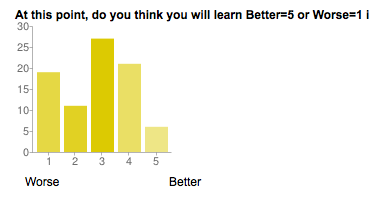
Survey One (1-5 range)
The only difference between the two questions is that Survey One was a range of 1-5, Survey Two was a range of 1-4.  The reason for this change is too many people pick the middle option with an odd number of choices.  An even number (4) forces them to make a clearer choice--research 101.  Most of those that chose the middle option trended toward "worse".

In Survey Two, I added a few new questions.  In one question a majority of students admitted to being distracted when they watched the video.  I feel many more were likely distracted, but they
Survey Two (1-4 range)
might not understand how distracted they actually were.

As I have said before, data doesn't tell the true story.  Even students who told me they watched the video couldn't name basic types of Islamic architecture.

This experiment has taught me one major lesson. Homework is not worth it.  Its not worth risking instruction, enforcement measures, disciplining noncompliance, increasing hatred of "learning" and school, or the TIME.   Students come to school for 8 hours.  How can we realistically expect them to do 2-3 hours of homework after 8 hours of school work.  Sports?  Job?  What about family time or hobbies?  In our culture?  Sure, we can fight it, but where does it get us?  On the other side of the coin, how many students succeed BECAUSE of homework?  How many would not learn without homework?  A Flipped video is just a different version of homework.  We might think, "all you have to do is watch a video".  Homework is homework to most kids.  Thanks to Joe Bower, I have a great new saying, "homework should be inspired, not assigned".   This is my new mission.

Flipped Classroom Report 1

Today was the first day of Flipping my class.  I think my method differs from the traditional model as I don't use quizzes to enforce the instructional videos.   My instructional videos are meant to provide a conceptual framework for the activities in class.  After watching my video today during my prep I realized its a bit dry--I need my goofy nature to shine through in my recorded instruction.  I gave a short anonymous survey today to all my students.  I wanted to see how many students watch the video before class--most of them did NOT watch the video.  It was, however, the first day of our Flipped class and a Monday.  

 For students who answered "No", I asked them why they didn't watch the video.  About 72% said they just forgot.  Only about 8 students out of 84 gave negative reasons for not watching the video. 

Of the students who watched the video, only 3 said they didn't understand the video.  The rest of them said they understood at least some of the video.
I hope this is some indication about the effectiveness of the video.  My next survey will ask about how effective the video was.  I also want to ask the kids for suggestions.  I have read about some people who say you should always include the teacher in the video rather than just a voice.   Despite all of the incredible presentation option, I thought I might go old-school and get out my video camera.  I have a huge projection screen--I can focus the camera on the screen and include myself in the video walking back and forth and pointing things out.  This is closer to the way I teach, so I think it will work better. 

The final question was answered on a scale.  I asked the students--"At this point do you think you will learn better or worse in a Flipped classroom".  This is a question I plan on asking throughout the experiment.